Eighty-four years. That is how long science went without officially describing a brand new species of howler monkey. While researchers have spent decades cataloging the familiar roars echoing through the South American canopy, the Amazon rainforest was quietly hiding two entirely distinct primates in plain sight.
Researchers from the University of Salford and international partners just shattered decades of taxonomic assumption. By combining genome-wide sequencing with physical museum specimens, the scientific team formally identified two new species: Alouatta iroi and Alouatta matogrossensis. Published in Communications Biology, the findings prove that even iconic, heavily studied animals still hold profound secrets. But this isn't just an academic victory. It is an urgent warning bell about habitat destruction in southern Amazonia, where bulldozers and agricultural expansion move faster than taxonomists can write papers.
How DNA and Museum Bones Exposed Hidden Species
For generations, wildlife biologists relied on physical traits—skull shapes, coat colors, and body sizes—to classify animals. This traditional approach created massive blind spots. When scientists looked at howler monkeys across South and Central America, they lumped several distinct evolutionary lineages into broad, catch-all categories.
The recent study changed the playbook by sequencing the genomes of eleven different howler monkey populations. When geneticists compared the DNA data alongside historical museum specimens, the family tree fractured. Populations that looked identical on the surface turned out to be genetically isolated lineages that hadn't shared an evolutionary path for hundreds of thousands of years. For another angle on this story, check out the recent coverage from Al Jazeera.
This breakthrough tackles two major hurdles in modern biology known as the Linnean and Wallacean shortfalls. The Linnean shortfall represents the staggering number of species still undocumented by science, while the Wallacean shortfall highlights our ignorance regarding where these animals actually live. By mapping the exact ranges of Alouatta iroi and Alouatta matogrossensis, researchers finally filled in crucial geographical missing pieces.
Why Rivers Built the Amazon's Primate Diversity
If you want to understand why the Amazon Basin boasts such wild primate diversity, look at a map of its massive waterways. Major rivers like the Amazon, Rio Branco, and Xingu didn't just carve through the landscape—they acted as evolutionary walls.
For millions of years, these wide, rushing rivers created impassable barriers for arboreal animals. A troop of monkeys stranded on one side couldn't cross to breed with groups on the other. Over countless generations, this geographic isolation forced populations to adapt independently. Mutations accumulated, physical traits shifted, and what started as a single group split into separate species.
It is a classic evolutionary story played out on a continental scale. Yet, these natural barriers are now being replaced by human-made fragmentation, which works much faster and far more destructively.
The Looming Threat of Southern Amazon Deforestation
Finding a new species is exhilarating, but the reality of where these animals live brings a heavy dose of reality. Consider Alouatta matogrossensis, which makes its home in southern Amazonia. This specific region faces some of the most aggressive deforestation rates on earth.
As agricultural frontiers expand and croplands chew through old-growth forest, the habitat fractures into isolated green islands. Because these newly recognized species haven't been formally evaluated for conservation status yet, conservationists don't even have official baseline data on their vulnerability. When habitats vanish this fast, animals can go extinct before we even figure out they exist.
Professor Jean Boubli from the University of Salford made it clear that time is running out. Rising temperatures, shifting climate patterns, and rampant habitat loss threaten countless Amazonian organisms before science gets a chance to understand them. Knowing what is out there is merely the first step toward keeping them alive.
Can Camera Traps and Wildlife Bridges Save Them?
Amidst the grim statistics of deforestation, small pockets of innovation offer a glimpse of hope. In places like Alta Floresta, Mato Grosso, conservationists are fighting back using low-tech and high-tech solutions alike.
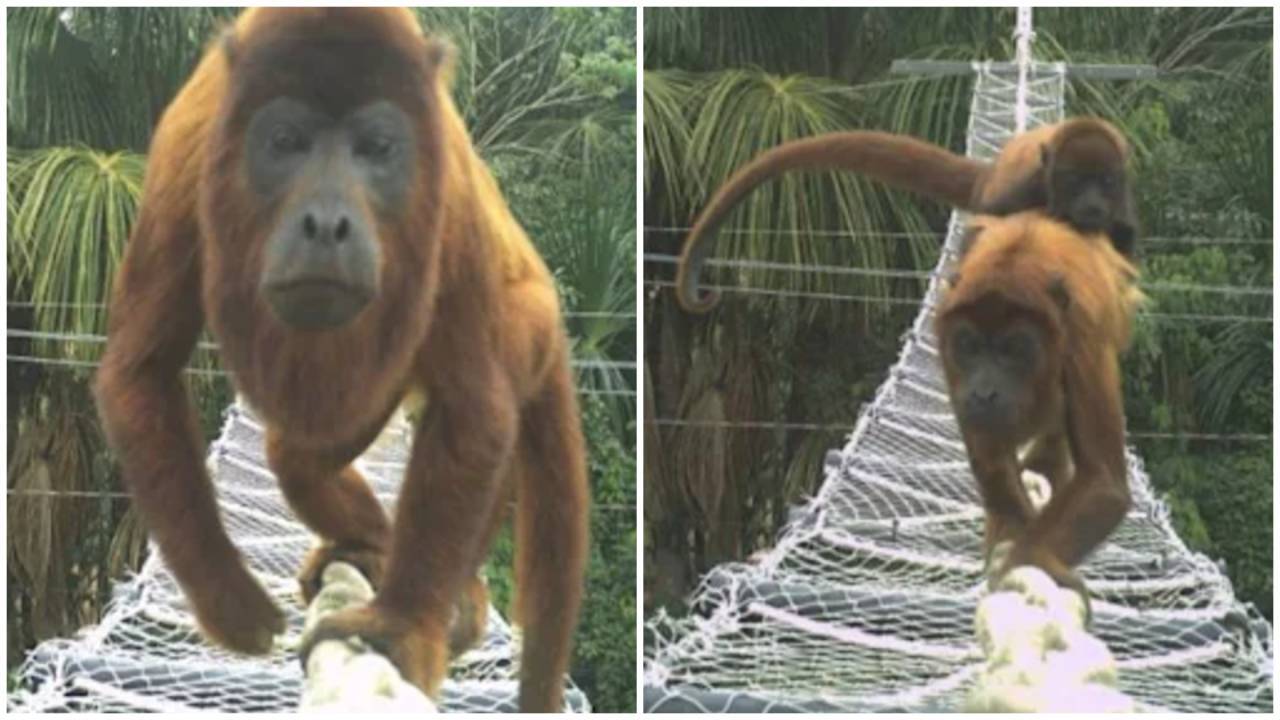
Recent camera-trap footage captured a female Alouatta matogrossensis carrying her infant across an artificial canopy bridge. These hanging crossings, installed by the Reconecta Project led by road ecologist Fernanda Abra, help arboreal animals safely navigate forest fragments divided by human infrastructure. Instead of being forced down onto dangerous roads or open ground where predators and vehicles wait, primates can use these overhead pathways to move between isolated patches of trees.
These structures won't stop large-scale deforestation on their own, but they provide a vital lifeline for fragmented populations trying to maintain genetic diversity.
Protecting the Amazon's newly revealed primates requires immediate action on multiple fronts. Conservation groups must prioritize funding for regions experiencing high rates of agricultural expansion, expand the network of wildlife canopy bridges across major road networks, and integrate genomic mapping directly into regional environmental policy before more hidden species disappear for good.