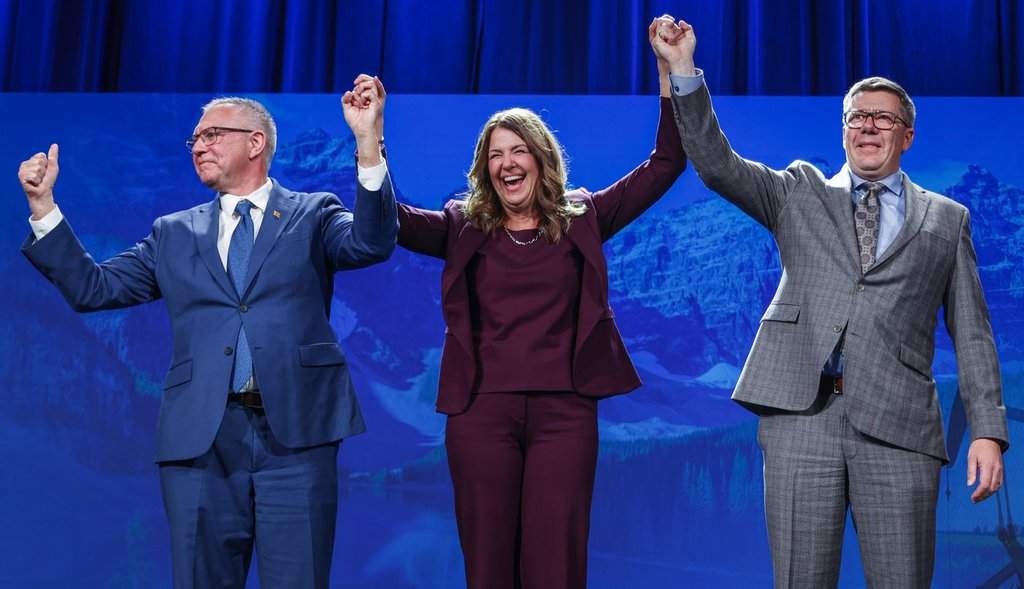
Walk into a Calgary convention hall with a few thousand restless party activists right after a bruising referendum, and you can feel the tension before anyone grabs a microphone. At the kickoff of Alberta's United Conservative Party annual gathering on Friday, November 27, 2026, Saskatchewan Premier Scott Moe and new British Columbia Premier Lorne Doerkson didn't show up for polite platitudes. They came to deliver a blunt warning. If UCP members stay divided over separation after last month's vote, they risk handing Alberta over to Naheed Nenshi and the Opposition NDP in the next provincial election.
Look at the photo above. Three western premiers standing side by side in front of Canadian and provincial flags. On paper, that's a rare moment of regional conservative alignment across British Columbia, Alberta, and Saskatchewan. In reality, getting the UCP base to pull in the same direction is the hardest test Danielle Smith has faced since taking the reins.
What Sparked the Warning at the UCP Kickoff
The timing tells you everything. Nearly six weeks earlier, on October 19, 2026, Albertans went to the polls on a referendum question about starting the legal process toward a binding vote on separating from Canada. Voters shut it down decisively. Official results from Elections Alberta show 1,556,316 votes—or 74.95 percent—backed staying in Canada, against 520,233 votes (25.05 percent) for pursuing a separation referendum process.
Scott Moe spelled out the stakes for the room in plain language. With Saskatchewan, Alberta, and British Columbia all governed by parties focused on economic growth, Moe argued that all that momentum and investment disappears the moment the West splits apart again. For a party that spent years courting populist grievances and constitutional friction with Ottawa, turning the page overnight isn't easy.
Honestly, that's why outside voices like Moe and Doerkson matter right now. When a premier tells her own activists to cool it on separatism, some die-hards hear betrayal. When neighbor premiers warn that infighting hands power to the NDP, activists have to weigh ideological purity against winning government.
Why Separatism Still Splits the UCP From Within
A 75 percent vote to stay in Canada sounds settled on paper. Inside party politics, a committed 25 percent minority with organized activists can still cause massive headaches—especially at a convention where a record 7,000 members are registered to attend and vote on policy and the party's board of directors.
After the October referendum, Smith shifted her tone. She made clear that people holding or seeking UCP leadership roles should accept the result—or look for another party if they want to keep campaigning for independence. The party even rolled out a declaration asking board candidates and constituency association presidents to abide by the referendum outcome.
Not everyone is playing along. Some local riding presidents have pushed back against signing the pledge, raising complaints about free expression inside the party. Meanwhile, pro-sovereignty organizers are running board candidates, and Smith loyalists have organized a slate called Team Unity—featuring figures like party vice-president and deputy chief of staff Patrick Malkin—to lock down control of the board.
In my experience watching big-tent conservative coalitions, convention board fights look inside-baseball until they spill onto the evening news. When rival factions whip members, cover registration fees to tilt a vote, or publicly spar over loyalty pledges, swing voters in Calgary and Edmonton notice. A party that looks like it's at war with itself struggles to look like a steady hand on the economy.
Lorne Doerkson and the Shifting Western Map
Bringing Lorne Doerkson to the stage wasn't just ceremonial. Doerkson became British Columbia's 38th premier on November 20, 2026, after leading the BC Conservatives to a 64-seat majority in the October 24 snap election that unseated David Eby's NDP. His cabinet mandate letters, released on November 24, laid out an aggressive agenda on health-care guarantees, reforming carbon pricing, scrapping no-fault auto insurance, and repealing B.C.'s Declaration on the Rights of Indigenous Peoples Act.
For Smith and Moe, Doerkson's win changes the regional chessboard. For years, western conservative premiers often complained about feeling boxed in by neighboring governments with different priorities. Now three provinces share a more aligned posture on resource growth and pushing back against federal constraints.
Still, let's not pretend regional alignment guarantees smooth sailing at home. Doerkson has his own governing challenges in B.C., from Indigenous leadership pushback over repealing DRIPA to delivering on big fiscal and health-care promises. And in Alberta, a friendly premier next door won't rescue the UCP if its own grassroots keep relitigating a referendum that three-quarters of voters just rejected.
What This Means Ahead of the 2027 Election
Alberta's next fixed provincial general election is scheduled for October 18, 2027, though it can be called earlier. Under Danielle Smith and Naheed Nenshi, the race is shaping up to be tight. Public polling leading up to the October 2026 referendum showed the UCP and NDP neck-and-neck—including a Mainstreet Research poll showing a 43 percent tie and a Pollara poll showing the NDP at 50 percent to the UCP's 46 percent.
On top of party division, the political calendar is already crowded. Legislation redrawing Alberta electoral riding maps has sparked fierce clashes in the legislature and raised the prospect of a court fight. In close elections, every single riding matters. Losing even a few urban or suburban seats because loyalists stayed home—or because separatist messaging turned off moderate voters—can flip a government.
There's also a legitimate debate inside Alberta about what "unity" actually means. Critics of Smith's top-down push argue that forcing loyalty pledges and sidelining vocal grassroots activists risks alienating energetic volunteers. Supporters counter that a governing party can't send mixed signals on leaving Canada when 75 percent of the electorate just voted to stay. Both sides have a point about coalition politics, yet the math of winning a majority in Alberta is unforgiving.
Practical Steps for Following the Fallout
If you're tracking whether this unity push holds or fractures before 2027, don't just listen to stage speeches. Watch the mechanics that show where real power sits:
- Check the board election results: Watch which slates and candidates win seats on the UCP board of directors this weekend—that tells you whether Smith loyalists or pro-independence organizers command the party machinery.
- Track riding association sign-offs: Pay attention to how many constituency presidents refuse or accept the referendum-abiding declaration, because local associations run nominations and ground games.
- Compare post-referendum polling: Look at credible Alberta polls over the coming months to see if the UCP closes the gap or trails the NDP once referendum headlines fade.
- Watch interprovincial policy friction: Follow how Doerkson, Smith, and Moe handle real-world trade, pipeline, and energy files—shared rhetoric is easy on a convention stage, while regional interests still collide in practice.