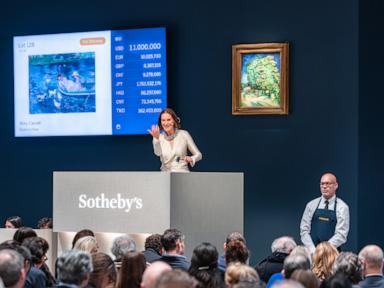
One hundred ninety point four million dollars. That's what Vincent van Gogh's Châtaigniers en fleurs—also known as Chestnut Trees in Blossom or Chestnut Trees in Flower—brought at Sotheby's in New York on November 18, 2026.
It shattered the artist's previous auction record of $117.2 million set by Verger avec cyprès (Orchard with Cypresses) at Christie's in 2022. Yet the real drama wasn't just the hammer price or the fact that the canvas had stayed out of public view for decades. Days before the gavel fell, descendants of Hedwig and Samuel Fischer pushed back over the painting's 1936 sale during the Nazi era, threatening to derail the whole evening until a last-minute agreement was reached with the Blaquier-Arrieta family and Sotheby's.
If you look at the headlines, you'd think art values move on pure aesthetic magic alone. Honestly, that's a fairy tale. When a nine-figure masterpiece hits the block, legal clearance, family negotiations, and buyer confidence decide whether the painting even gets a fair shot in the saleroom.
Why a disputed van Gogh auction record changes how collectors think
At first glance, paying $190.4 million for an 1890 landscape painted in Auvers-sur-Oise looks like irrational exuberance. Van Gogh finished the work in May 1890 after leaving a psychiatric asylum, roughly two months before his death in July. Scarcity matters here. Late works from that final stretch carry intense emotional and art-historical weight.
Still, rare paintings don't automatically command record sums if clouds hang over title and provenance. According to reporting from the Associated Press and The Art Newspaper, a lawyer representing the Fischer heirs requested a postponement so Sotheby's could address whether the 1936 sale happened under duress.
Here's what separates seasoned buyers from wishful thinkers. Serious bidders hate unresolved disputes. A cloud over Nazi-era transactions doesn't just create moral pressure—it creates litigation risk, export headaches, and museum loan obstacles down the road.
By announcing a mutually satisfactory resolution between the Blaquier-Arrieta family (owners since 1975) and the Fischer descendants right before the auction, Sotheby's cleared a massive hurdle. Details of the agreement stayed private, and the Fischer heirs expressed gratitude for fair collaboration that acknowledged family suffering during the Nazi era. Without that settlement, paddles might've stayed firmly down.
Provenance isn't paperwork—it's price protection
People who don't spend time around high-value art often treat provenance like a footnote at the bottom of a catalog entry. That's a mistake. Provenance is the asset's legal backbone.
In my experience watching major sales unfold, sellers frequently underestimate how thoroughly buyers vet history when eight or nine figures are on the line. You can't bluff your way through a $100 million-plus transaction with vague assurances. Sophisticated collectors hire outside researchers, check restitution registries, and scrutinize every gap in ownership.
Even with the deal announced ahead of time, the broader 12-work sale from the collection of Nelly Arrieta de Blaquier and Carlos Pedro Blaquier totaled $412 million, falling shy of roughly $450 million in pre-sale expectations. Paul Cézanne's Arlequin brought $111 million against a $120 million estimate, and a few lots were withdrawn or passed. Even blockbusters face reality checks when estimates aim high.
What buyers actually scrutinize before bidding
- Nazi-era and war-era gaps: Any transaction between 1933 and 1945 draws intense examination, especially when Jewish families or European collectors are involved.
- Public exhibition history: Works hidden in private collections for decades feel thrilling to discover, yet long gaps require rock-solid documentation to reassure nervous buyers.
- Total cost including buyer's premium: Headlines often cite the headline figure with fees—$190.4 million in this case—so smart buyers calculate their true all-in number before making a single gesture.
Where this van Gogh sits among the priciest paintings ever sold
Breaking a personal record for van Gogh is huge news, though context keeps things grounded. Across all public auctions tracked by ARTnews, Châtaigniers en fleurs ranks among the top tier of paintings ever sold at auction, trailing works like Leonardo da Vinci's Salvator Mundi ($450.3 million in 2017) and Gustav Klimt's Portrait of Elisabeth Lederer ($236.4 million in 2025).
Why does a single artist's record matter so much when other masters sit higher on the all-time chart? Because collectors compare within an artist's own output. When a major van Gogh resets the ceiling from $117.2 million to $190.4 million, it reframes what other top-tier works by that artist might command in the future.
At the same time, don't assume every van Gogh gets an automatic lift. Market strength concentrates heavily at the very top—iconic subjects, pristine condition, clear title, and strong institutional interest. Mid-tier works still have to earn their keep.
Look at how van Gogh handled trees and foliage during his final years—expressive brushwork, charged color, and dense visual rhythm. That late-period intensity is a big reason Châtaigniers en fleurs commands such fierce attention, even though it isn't as universally famous at a glance as Sunflowers or The Starry Night.
Debatable territory—resolution vs. full transparency
Not everyone cheers when a restitution dispute ends with an undisclosed agreement. Some observers argue that keeping terms confidential leaves questions open about how historical grievances were weighed against commercial speed. Others point out that private settlements often spare families years of grueling litigation while delivering concrete recognition and closure.
Both perspectives carry weight. Transparency builds public trust, yet families negotiating sensitive history sometimes prefer privacy over public spectacle. What matters most is that the parties directly involved—the Fischer descendants and the Blaquier-Arrieta family—reached terms they were willing to stand behind so the auction could move forward.
Practical next steps if you follow or buy art
Whether you're bidding in major auctions or simply following high-stakes art news like a hawk, a few habits will save you headaches:
- Read past the headline price. Check whether a quoted figure includes auction fees and compare it against pre-sale estimates and prior records by the same artist.
- Treat provenance as a dealbreaker, not a detail. If you ever evaluate a work for purchase or research, verify ownership continuity before falling in love with the picture.
- Watch how disputes get resolved. Pay attention to whether claims are settled privately, litigated in court, or backed by independent archival review—each path shapes long-term market confidence differently.
- Separate auction hype from broader market health. One record sale proves appetite for rare trophies; look across an entire evening sale—including passed or withdrawn lots—to see how the rest of the room actually performed.